
 |
| Castlevania: Symphony of the Night |
Welcome to Retro Glitch, a retrospective of the gaming industry’s most shining moments prior to the advent of DLC, micro transactions and online multiplayer. In this entry we’ll be taking an in depths look at the process and circumstances that led to Konami’s masterpiece Castlevania: Symphony of the Night; as well as its narrative, themes, characters and aftermath.
 |
| A memorable event in gaming, marking the first appearance or footage of games such Metal Gear Solid and Ocarina of Time |
The secret to success
The production of the game was led by Toru Hagihara acting as the director and Koji Igarashi as the assistant director. Igarashi is said to have had the greatest creative influence behind the game, performing duties as both one of the programmers and the writer. Igarashi began working for Konami in 1989 straight out of college. His first project was for the company’s Educational Software Department, although the title he worked on never saw a release. Igarashi’s first game to be released was Detana!! TwinBee an arcade shoot-‘em-up well received by gamers. His other works included the arcade shooter classic Gradius II and Tokimeki Memorial a popular dating simulator; so popular in fact he was asked to do a sequel. Having no desire to do so he felt his expertise would be better utilised on another project.
 |
| Koji Igarashi |
Igarashi transferred to the Castlevania development team, he was immediately set to work on Symphony of the Night. Back then the game was intended to act as a supplementary story to the main series; or a gaiden as they’re more commonly known in Japan. But the narrative presented by Igarashi allowed it to extend one game while standing out as its own entry in to the main compendium. His approach was simple; if the Castlevania series had been a success up until this point then it wasn’t broken, and if it wasn’t broken it didn’t need to be fixed. Instead Igarashi and the team focused on breaking the barriers that were set by previous games; such as its linear progression, and by improving its flaws like replay value. Symphony changed to a non-linear game play; which would require players to back track throughout the castle and learn unique skills in order to explore its entirety. The game itself could be played through with a variety of characters and even held a secret at the end that almost doubled its play time length. It broke some conventions such as having a non-Belmont save the day, and implementing an RPG aspect allowing for the player to level up their character and assets. His input and vision helped shape the structure of Symphony of the Night and subsequently as a result the rest of the Castlevania series; to which he has since acted as the overall architect to.
 |
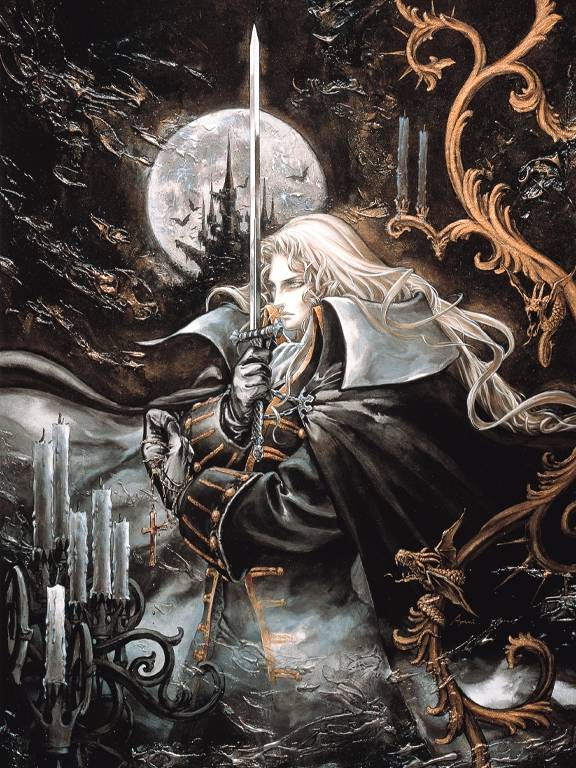
| Tranquil yet terrifying artwork by Ayami Kojima |
Igarashi wasn’t the only series favourite to get their start
in Symphony of the Night; next time we’ll be taking a look at the woman who
crafted the unique visual identity of the series, Ayami Kojima. Her tragically
beautiful acrylic portraits paint the iconic imagery only a game like Symphony
of the Night can live up to.
Written by Silas Grayson

No comments:
Post a Comment